
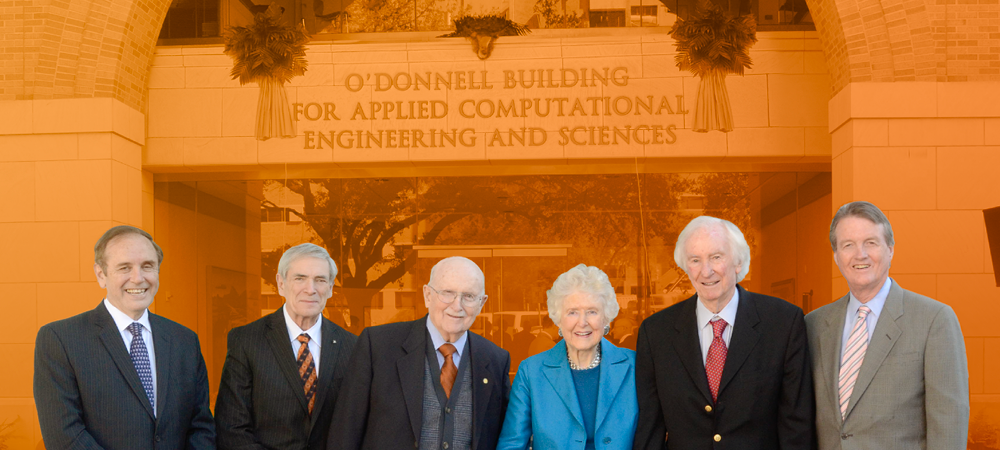
Over more than 40 years, the O’Donnell Foundation has created more endowments at The University of Texas at Austin than any other funder. Their impact across campus has been monumental — gifts to the Clements Center for National Security, fine arts, engineering and natural sciences advance groundbreaking research and experiences every day. But the Foundation’s part in powering UT’s transformation of Austin into a global technology leader perhaps most exemplifies the vision and drive of Peter and Edith O’Donnell.
Predicting a Wave — and Leading the Way

These two moments, two decades apart, helped create one of the most celebrated and cutting-edge computing programs in the world: the Oden Institute for Computational Engineering and Sciences at UT Austin.


Rise of the Super Computers
“Super computing is going to change everything,” Peter O’Donnell predicted in 1985. The 40 subsequent years of computing ubiquity have borne out that prediction, perhaps more than O’Donnell even imagined.
“Computer science was a popular major at UT in the 1980s, but there was not enough equipment to go around. They had fist fights over who would get access to the machines,” said O’Donnell in his memoir “Improving Education, Changing Lives.” In 1985, when O’Donnell learned that UT planned to establish the UT System Center for High Performance Computing, he recommended — and funded — the purchase of a CRAY X-MP/48, the most powerful computer system available at the time.
“Leadership in high-performance computing is an essential element of leadership in research,” O’Donnell said. “By reaching out to provide the best that is available at this time, the UT System not only is moving ahead on a broad front of science, but also achieves a milestone in developing a great research university in Texas.” This visionary leadership, accompanied by the transformational philanthropy that powered implementation of his vision, came to define the involvement of Peter O’Donnell and the O’Donnell Foundation at UT across the ensuing 40 years.
O’Donnell and Oden – A Beautiful Friendship
That January 1991 meeting led to a historic friendship between Peter O’Donnell and father of computational mechanics J. Tinsley Oden. They worked together closely to create what is now known as the Oden Institute for Computational Engineering & Sciences — an interdisciplinary community recognized as one of the top computational research institutes in the world.
O’Donnell and Oden understood that computational science and engineering was a new frontier of great importance. Through the improvement and widespread adoption of computer modeling and simulation, researchers could speed development of other critical technologies. These new techniques could provide new solutions to complex problems including enhanced energy recovery, coastal protection, disaster response, materials discovery and patient-specific cancer care.
Thanks to the unwavering generosity of the O’Donnells, Oden recruited the most talented computational scientists in the field — many of whom went on to work and teach at UT for 30 years or more, producing innumerable and invaluable foundational texts and radical advancements in the field of computing. Their team not only expanded the mathematical agility of computational science and engineering as a discipline, but also advanced the number of potential real-world applications.
“Computational science and engineering is key to the global strength of American industry,” O’Donnell said — and he was right.
A Home for Computational Engineering
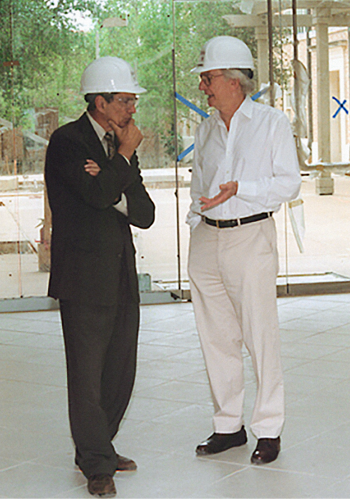
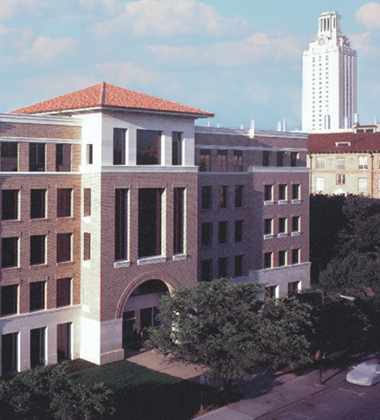
In 1995, four years into his working relationship with Oden, Peter O’Donnell set in motion the process that would result in a new home for what is now the Oden Institute. He identified the necessity for a home that could break down the silos that existed between researchers, faculty, students and industry scientists — a home that could bring physical science, mathematical modeling, applied mathematics, engineering, computer science, software engineering and visualization all under one roof. The opportunity arrived in 1997, and the O’Donnell Foundation supported the construction of a new six-story, 180,000-square-foot building that could house 300 graduate students, 70 faculty members, 42 post-docs, 36 visitors from industry and academia, and 40 staff members.
O’Donnell’s memoir describes the excitement surrounding the new facility: “The possibilities for discoveries in the building were endless. Researchers would be able to study chemical processes that occur in nanoseconds or natural events that occurred over thousands of years, such as soil erosion. They would be able to see what happens after an oil spill in the Gulf of Mexico, how fast the spill would move, and what chemicals would be needed to clean it up. Machine parts could be designed and tested before manufacturing.”
During the two-year construction period, O’Donnell made more than a hundred trips to Austin, catching pre-dawn flights to attend weekly 8 a.m. construction meetings with University leadership, the design team and contractors. From the building’s wiring to the art to the food served at the café, O’Donnell was involved in every part of the building’s creation. As former Texas governor and close friend of O’Donnell Bill Clements told the Austin American-Statesman: “Pete is a doer. If he really gets involved, he’s going to give time and effort and energy to get something done.”
The Oden Institute – A Vibrant Hub of Computing Innovation
From the day they met through the day the foundation closed its doors in June of 2026, Peter O’Donnell and the foundation that bore his name were powerful supporters of the field-defining work done at the Oden Institute. The foundation’s resources advanced work across five key areas:
- Student support: In the national fight for top students, generous fellowships are key. O’Donnell-powered fellowships have helped to recruit and support hundreds of students who will lead the field once they graduate and help them successfully complete the “Iron Man of Ph.D. programs”: a program requiring graduate-level proficiency in all three fields of mathematics, computing and a scientific application domain.
- Faculty recruitment and retention: The O’Donnell Foundation named chairs and anonymously supported many more, helping UT fight a winning battle in recruiting 25 chaired faculty members away from top institutions worldwide.

Karen Willcox
Director, Oden Institute
Peter O’Donnell, Jr. Centennial Chair in Computing Systems
W. A. “Tex” Moncrief, Jr. Endowment in Simulation-Based Engineering and Sciences – Endowed Chair No. 5

Karen Willcox
Director, Oden Institute
Peter O’Donnell, Jr. Centennial Chair in Computing Systems
W. A. “Tex” Moncrief, Jr. Endowment in Simulation-Based Engineering and Sciences – Endowed Chair No. 5

O'Donnell Faculty Highlights
Whether the chairs bear the O’Donnell name or not — O’Donnell donated much of his funding anonymously and in partnership with his friends like Tex Moncrief — the impact is a testament to his generosity and commitment to excellence at UT Austin.

Thomas J.R. Hughes
John O. Hallquist Distinguished Chair in Computational Mechanics
Peter O’Donnell, Jr. Chair in Computational and Applied Mathematics
Lead Computational Mechanics Group
Professor Aerospace Engineering & Engineering Mechanics
One of the most recognized and celebrated scholars at UT and one of the world’s most widely cited authors in Engineering Science, Hughes’ contributions across the fields of aerospace engineering and computational mechanics are vast. His computational methods have transformed how complex physical systems are modeled across aerospace, automotive, and biomedical industries, enabling customized pulmonary heart valve replacements and full-vehicle in silico crashworthiness and impact testing.

W. A. “Tex” Moncrief, Jr. Endowment in Simulation-Based Engineering and Sciences – Endowed Chair No. 6
Professor Physics
The author of the globally used EPW code, Giustino is a pioneer in modeling and simulation for quantum materials. His work to simulate electron-phonon interactions and predict material behaviors has led both to fundamental quantum understanding and to the discovery of new materials that are safer alternatives to lead-based materials used in solar cells.

Charley Taylor
W. A. “Tex” Moncrief, Jr. Endowment in Simulation-Based Engineering and Sciences –
Endowed Chair No. 7 – Computational Medicine
Director Center for Computational Medicine
Professor Medicine
The inventor of the most widely adopted artificial intelligence technology in U.S. healthcare, Taylor is an internationally recognized leader in artificial intelligence, biomedical modeling, and digital twin technology. His research develops patient-specific digital twins to simulate disease progression, predict outcomes and personalize care for patients.
O’Donnell and Moncrief – Beyond Energy
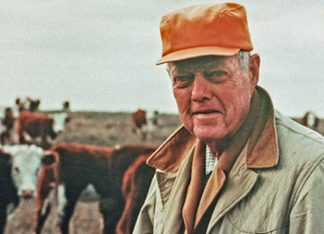
W. A. “Tex” Moncrief, Jr. was born in 1920 to a family of legendary wildcatters. The Moncrief family was a part of many major historic oil and gas discoveries in East and West Texas, the Gulf Coast, Louisiana, New Mexico and Wyoming. In addition to his business acumen, active military service during WWII, and 16-year tenure on the UT System Board of Regents, Tex was a dedicated philanthropist of the highest order.
On that date, Tex, who knew O’Donnell well, having partnered with him on other philanthropic activities, matched the challenge. “This remarkable philanthropy,” says Oden, “undoubtedly put the University at the forefront of research and academic study in computational science worldwide.”
The philanthropic partnership between Moncrief and O’Donnell did more than power a best-in-class computing institute at UT; it diversified the trajectory of economic might in the state of Texas.
University-wide Impact
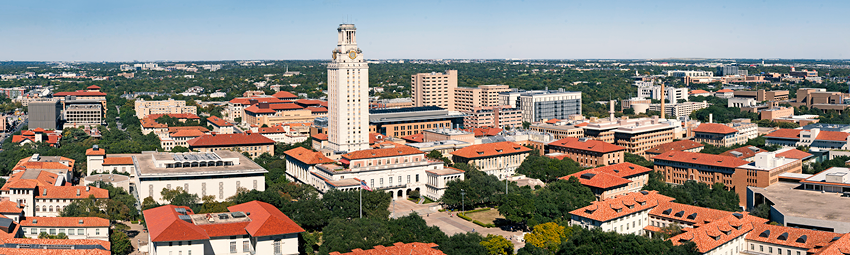
His investments of more than $100 million accelerated the growth of the College of Natural Sciences and the Cockrell School of Engineering, strengthening the faculty and research enterprise at UT that continue to benefit the state and the nation.
“Peter O’Donnell was one of the most consequential university philanthropists in Texas history,” said William Inboden, Executive Vice President and Provost. “He recognized that great universities drive innovation, economic growth and opportunity, and he invested accordingly. His support helped build the faculty strength, research capacity and culture of excellence that transformed UT Austin, fueled Austin’s emergence as a technology leader, and continues to benefit students, scholars and the people of Texas today.”
“Peter was an unforgettable, indefatigable visionary and organizational genius who devoted his life, wealth and energy to pursue his often-stated mission: to transform the economy of his beloved Texas to one that thrived on advances in science and technology.”
J. Tinsley Oden
Influence and Impact: After Sunset
In September 2016 in Austin, O’Donnell, age 92, and Tinsley, age 80, looked ahead to the next big thing. With AI just cresting the horizon, it was becoming clearer than ever that ever-expanding computing power would be the key to unlocking exponential new levels of human health and wellbeing. As it became time to recruit a new director to lead the institute into this future, the O’Donnell Foundation was there again, gifting the Peter and Edith O’Donnell Distinguished Chair to aid with the recruitment of Karen Willcox from MIT.
Today, the institute that they created to harness that power and lead that field continues to grow, with 25 research centers and groups, 146 faculty, and over 105 students enrolled in its own Ph.D. and master’s programs, while directing a research portfolio of over $130 million in sponsored research funding. While the foundation that helped create so much of this growth is sunsetting, the momentum they have built and the discoveries they have powered leave behind a foundation, world-renowned professors and researchers, and body of work that is unparalleled nearly anywhere in the world.
“Peter was an unforgettable, indefatigable visionary and organizational genius who devoted his life, wealth and energy to pursue his often-stated mission: to transform the economy of his beloved Texas to one that thrived on advances in science and technology,” said Oden. “He was a dear friend whose impact on education at UT and all of Texas is unparalleled. His friendship and great generosity will always be remembered and honored and cherished.”
Texas Leader Magazine
More from this series

From the President
President Jim Davis on the momentum of the What Starts Here campaign

A Bridge Across Time
Camille and Sandy Kress focus on their passions with a gift to the Harry Ransom Center.

Leading With Heart
Carla and Arthur Mills IV provide MBA students hope and a deep sense of belonging.