
Giant Leaps
A visionary gift
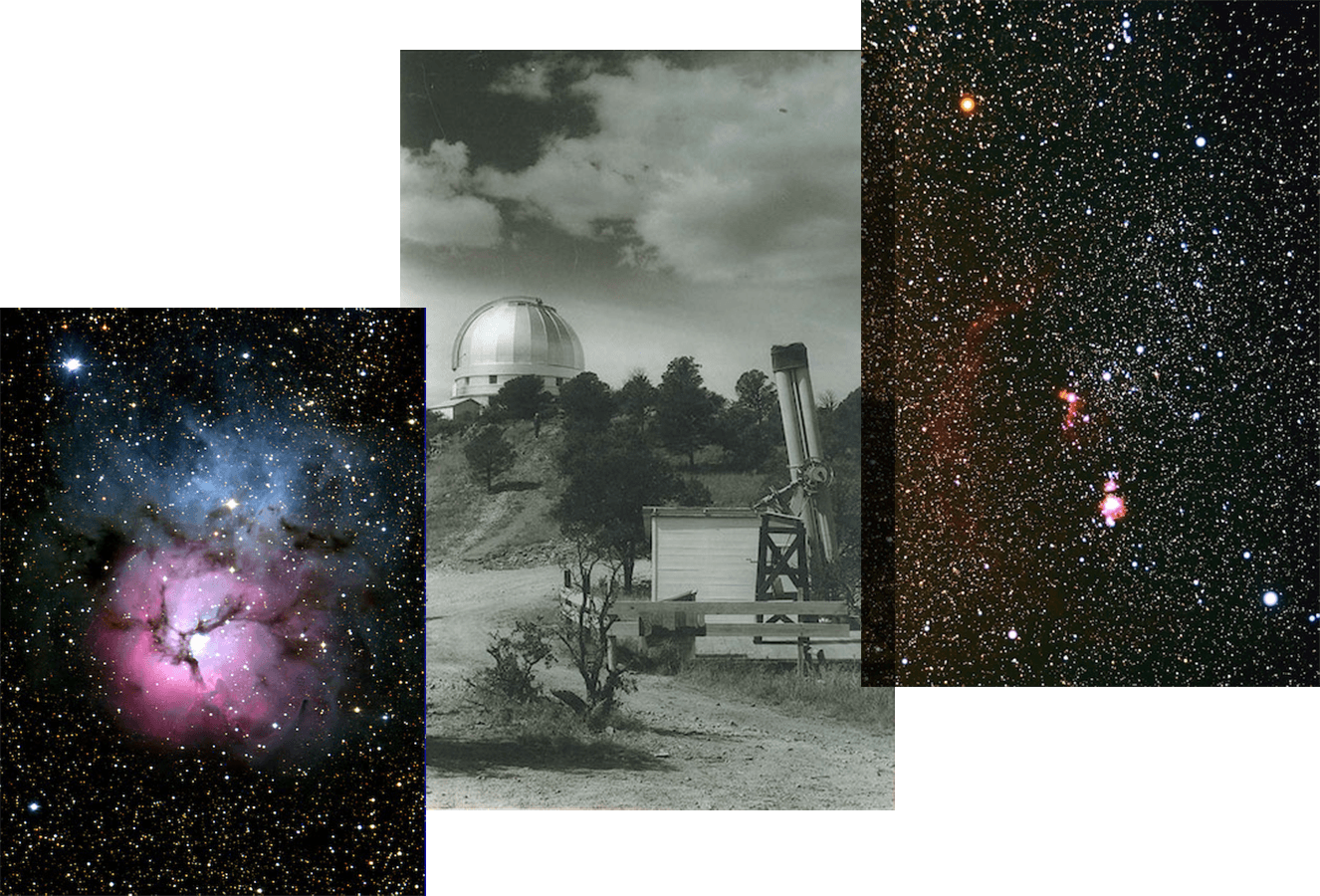
Before McDonald Observatory was one of the world’s leading centers for astronomical research and education, it was an idea. William Johnson McDonald, a banker from Paris, Texas, left most of his estate to The University of Texas at Austin to establish an observatory —nearly 40 years before UT would establish its Department of Astronomy. McDonald’s generosity and vision became the foundation for discoveries still being made a century after his lifetime, and his legacy continues to help attract talented space scientists to UT.
Apollo’s legacy
Buzz Aldrin placed the first Laser Ranging Retroreflector on the moon during the Apollo 11 mission and UT astronomers continued the experiment for four decades. McDonald scientists used laser beams aimed through telescopes to illuminate the reflectors, measuring the distance between the moon and Earth and helping us to better understand the moon’s orbit, the rotation of the Earth, and Einstein’s theory of relativity.
Next-generation knowledge
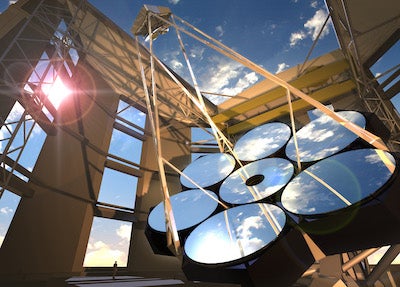
In May, Austin philanthropist David Booth committed a $10 million gift to support UT’s involvement with the Giant Magellan Telescope. Once completed, the GMT will be the world’s largest telescope, providing unprecedented views of the universe. As one of only 12 founding institutions worldwide, UT will be one of a few American universities that can offer its researchers, faculty and students access to a next-generation telescope for groundbreaking research. “I saw a rare opportunity to support a very exciting project that not only expands our view of the universe, but also pushes the boundaries of scientific discovery,” Booth says.
The future of space and Earth science
Understanding space starts with understanding Earth. Now under construction at the observatory is the McDonald Geodetic Observatory, a scientific facility devoted to geodesy, or the science of Earth’s shape, gravity and rotation. The MGO, part of a network of 30 sites for NASA’s Space Geodesy Project, will bring together scientists and engineers from UT’s Cockrell School of Engineering, Jackson School of Geosciences, Applied Research Laboratory and College of Natural Sciences to explore diverse interests including space research, global change and minimizing the impact of geohazards like earthquakes and sea-level changes.
Your place in the universe
Your gift to McDonald Observatory supports breakthrough discoveries about space— and life-changing science experiences for students across the country.
Learn more about becoming a Friend of McDonald or a member of McDonald’s Board of Visitors at mcdonaldobservatory.org/support.
Changing the world
More from this series
Leading Lives of Purpose
With the help of generous donors and excellent faculty, UT’s new School of Civic Leadership will shape the next generation of leaders who are prepared to strengthen our communities, our state, and our nation.

Art — For Life
The Alexander Pavilion will anchor the new plaza at the heart of UT’s arts and entertainment corridor, providing a world-class gathering place for the many students, artists, and members of the public who attend Texas Performing Arts’ great performances each year.
The O’Donnell Foundation
After nearly seven decades of extraordinary impacts and investments in transformational causes in Texas and around the world, the O’Donnell Foundation is sunsetting in alignment with the wishes of its late founders, Edith (B.A. ’48, UT Distinguished Alumnus Award winner) and Peter O’Donnell, Jr.